The “70 PPM Lie” a Gas Company Tech Exposed in My Hallway — and Why It Quietly Kills 400+ Americans in Their Sleep Every Year
I blamed my headaches on the pregnancy. My toddler’s on daycare. For eight months the three of us had been breathing poison in our own home — and the carbon monoxide detector on the wall never made a single sound. The light stayed green the whole time.

The HVAC Tech Found What My Detector Hid for 8 Months
It started as a furnace check I’d put off for two years.
November. The first real cold snap. I was six months pregnant, bone-tired, and my two-year-old had been waking up with headaches I kept blaming on teething. I had them too — a dull throb that showed up every evening and was gone by mid-morning. Pregnancy. Stress. Bad sleep. That’s what I told myself.
The HVAC tech was in our basement maybe ten minutes before he came back up with a look I still can’t shake.
“Ma’am — when’s the last time anyone checked your heat exchanger?”
I didn’t even know what that was. He didn’t explain right away. He just pulled a handheld meter off his belt and started walking toward the hallway. I watched the number climb. 18… 24… 31…
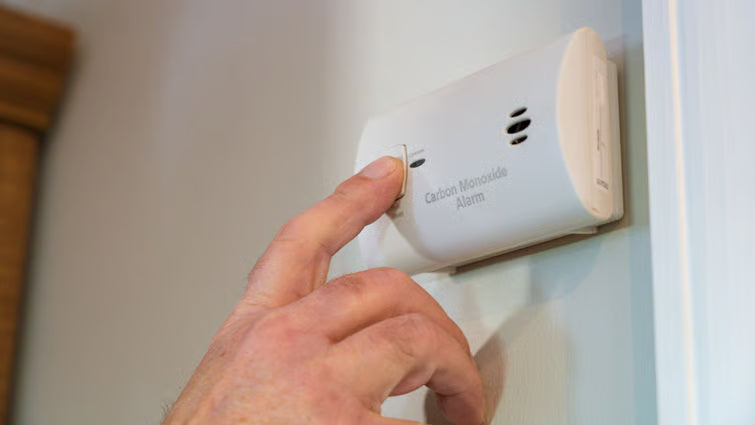
He stopped under the carbon monoxide detector screwed into our wall. Green light glowing. Silent. The same as it had been for eight years.
“You’re at 35 right here,” he said. “High enough to make you sick. Not high enough for that thing to care.”
I asked what he meant. He tapped the detector.
“These don’t go off until 70 parts per million. And even then it can take one to four hours before they make a sound. You’ve been breathing this for months. The detector knew. It just didn’t think it was worth telling you yet.”
I put my hand on my belly. The light was still green.
“I See This Every Week”
After the HVAC tech left, I called the gas company’s emergency line. I needed someone official to tell me how bad it really was.
They had a technician at my door within the hour. The second he stepped inside, his meter started pinging.
“27 right here in your entryway,” he said. “We evacuate homes at 50.”
He walked every room. Kitchen: 31. Hallway: 35. My daughter’s bedroom — where she slept every single night — 38.
I pointed at our detector. Green light. Silent. “Why didn’t it go off?”
He shook his head. “Because it isn’t built to. Not until 70. You’re at 38 — enough to make your whole family sick. Not enough for that thing to care.”
I asked if we’d just been unlucky. He looked at me and said three words I’ll never forget:
“I see this every week.”
Every week. Families breathing poison. Detectors glowing green. Sensors that passed every test.
“The problem isn’t broken detectors,” he said. “It’s detectors doing exactly what they were built to do — stay quiet until it’s almost too late.”
The “70 PPM Lie” That’s Killing 400+ Families a Year
After that day, I couldn’t let it go. I spent weeks reading — safety standards, CDC data, Reddit threads full of families describing their own near-misses. What I found made me sick.
Here’s what the detector industry would rather you didn’t know. The safety standard most cheap CO alarms are built to (UL 2034) doesn’t even require them to sound until levels reach around 70 PPM. And even then, not right away:
- 70 PPM → alarm in 60–240 minutes
- 150 PPM → alarm in 10–50 minutes
- 400 PPM → alarm in 4–15 minutes
Read that again. At 70 PPM — the moment your detector finally decides to wake up — you and your family have already been breathing poison for one to four hours.
Your kids breathing it in their sleep. Your parents breathing it in theirs. And the light stays green, because the rules call that “acceptable.”
- 400+ Americans die from accidental carbon monoxide poisoning every year.
- 100,000+ end up in the ER.
- About 84% of incidents happen between November and February — when the furnace runs all night and the windows stay shut.
Almost every one of those families had a “working” detector on the wall.
Why Cheap Detectors Fail American Families
Cheap detectors have three fatal flaws — and every one of them costs families:
Flaw #1: They wait until it’s almost too late. No alarm until 70 PPM. By then you’ve been breathing poison for hours — and your kids have been breathing it in their sleep.
Flaw #2: They show a light, not a number. You have no idea what’s actually in your air. Levels can climb all night and you’d never know until the symptoms hit.
Flaw #3: They don’t detect natural gas. If your stove, furnace, or water heater leaks raw gas, those detectors stay completely silent.
But here’s the real trap: the design itself makes you feel safe when you’re not. You see the green light and relax. You hit the test button, it beeps, you trust it again. Except that test button only checks the battery and the speaker — not whether the sensor still works. You can have a dead sensor that passes every test you run.
And the same detectors that stay silent in a real emergency will scream at 3 AM over nothing. I found hundreds of families living it:
“Our CO detector has gone off 5 times this month. Always between 2 and 5 AM. My kids are terrified.” — from a parenting forum
One mom’s husband finally ripped theirs off the wall after the false alarms. A few weeks later she ran the gas fireplace and got dizzy. “We were at about 85 PPM. Pretty sure I almost killed my whole family.”
Cheap detectors cry wolf until families unplug them — then go silent when it’s real. The system isn’t just broken. It’s built to fail.
What the Pros Actually Use
After everything, I started asking the people who walk into these emergencies for a living — the HVAC tech, the gas company technician. Same question every time: “What detector do YOU trust?”
Same answer:
“One that shows actual numbers. Real-time PPM. So I know exactly what’s in the air — not just that the power’s on.”
The gas company tech put it plainly:
“If you’ve got kids or older folks in the house, get something that reacts at a much lower level. Standard alarms don’t go off until it’s already bad.”
That’s the first time I heard the name SecureBreath.
The Detector That Doesn’t Wait Until You’re Poisoned
SecureBreath is nothing like the detectors I’d lived with. There’s no green light. There’s a screen. With a number on it.
When there’s no carbon monoxide in the air, it reads “0.” Not a light that could mean anything or nothing. A real zero. In real time. Every second. You don’t hope your family is safe — you see it.
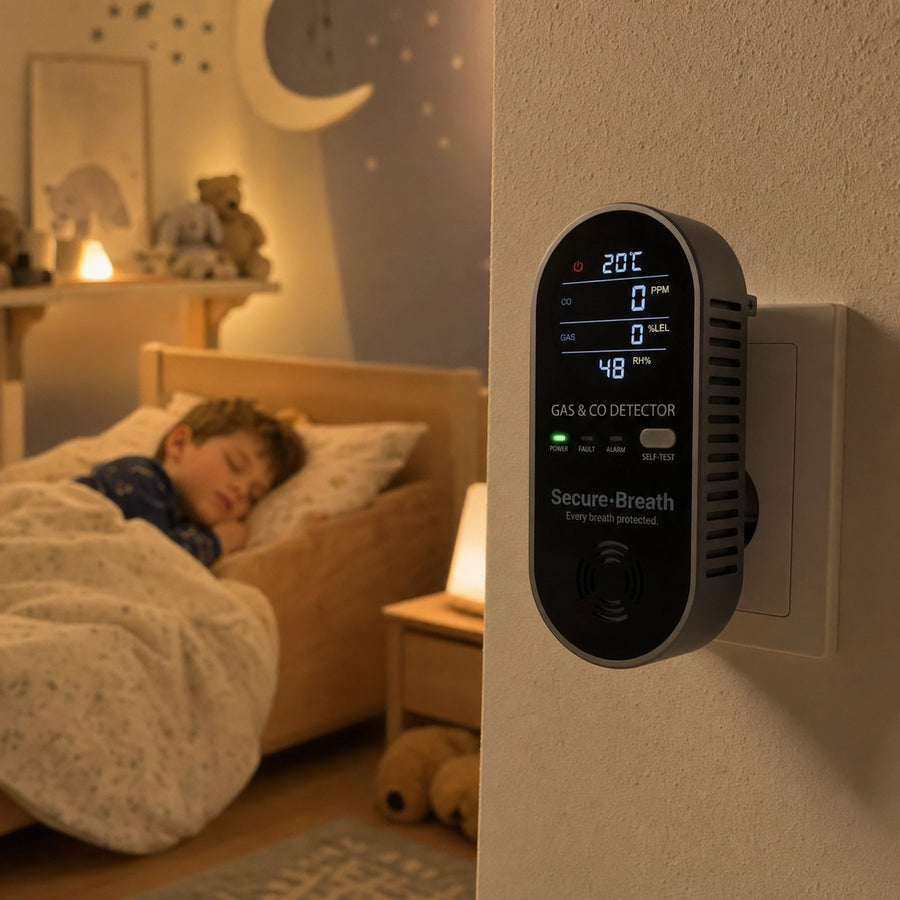
And unlike the detectors that sit silent until 70 PPM, SecureBreath shows the number the moment it starts to rise. 10 PPM? You see it. 35 — the level that poisoned my family for months? You’re already opening windows and calling the gas company, hours before a standard alarm would make a sound.
4-in-1 Protection
SecureBreath watches for every threat at once:
- Carbon monoxide — from the very first PPM, not at 70.
- Natural gas — catches leaks from the furnace, stove, and water heater.
- Propane — for homes with propane appliances.
- Temperature & humidity — for a healthier home.
No gaps. No blind spots. Real protection.
My Family’s Transformation
I ordered SecureBreath that night. Four units. I plugged the first one in by the new furnace and the screen lit up: “0.”
For the first time since that day, I actually knew my family was safe — not because a green light told me so, but because I could read the proof. I put the second in the kitchen by the stove. The third in the hallway outside the bedrooms, right where the old one had glowed green while it poisoned us.
Now I check them with a glance every morning, coffee in hand. Zeros across the board. That’s all I need to see.
Our daughter was born in March. Healthy. Ten fingers, ten toes. I cried when the doctor said everything looked perfect — because mine had warned me that low-level CO during pregnancy can cause real harm, and we’d caught it with barely any time to spare.
My mother-in-law had a detector from 2009 on her wall. Fifteen years, green light glowing. I bought her a SecureBreath for Christmas. “I test it every month and it beeps,” she said. “I thought that meant it worked.” I know. I thought so too.
Now she texts me every week: “Still zeros. How about that.” I like that just fine.
The Real Cost of a Cheap Detector
Here’s something that still bothers me: most hardware stores don’t even carry professional-grade detectors. Why? Because the cheap ones have better margins. They cost a few dollars to make and sell for $25. Stores earn more on the products that don’t actually protect you.
Let me be blunt with my own numbers. My ER visit after we found the leak? $2,400. The follow-up appointments for the baby? $800. In a multipack, SecureBreath works out to under $50 per detector.
Do the math. But honestly, it was never about the money.
- Professional-grade electrochemical sensor — the same kind the gas company tech carried.
- Real-time digital display — see the actual number, not a meaningless light.
- 3-in-1 detection — carbon monoxide, natural gas, and propane in one unit.
- Alerts from the first PPM — not at 70, when it’s already too late.
- Plug-in design — no ladder, no wiring, no electrician. Ready in 30 seconds.
The gas company tech told me something I think about a lot:
“I recommend SecureBreath after every call like yours. The green-light detectors are just liability checkboxes. This one actually protects your family.”
I’ll say it straight: a single green-light detector can cost a family everything. That’s the price nobody prints on the box.
It’s about glancing at a zero on your way out the door and knowing — not hoping — that the people you love slept safe. It’s about never becoming the family the gas company tech talks about on his next call.
Your Family Deserves Real Protection
The manufacturer only runs new production batches every few months, and with demand this high a sell-out can mean weeks before SecureBreath is back in stock. Right now they’re offering their best pricing:
Each order includes: ✓ Lifetime replacement warranty✓ Free shipping
Two Futures
Future one: you keep trusting the green light and hope it means something — and risk becoming one of the 400+ families who don’t wake up this year.
Future two: you see exactly what you’re breathing, every second, and you know your family is safe.
The choice seems obvious. Don’t wait for your family’s close call. I got lucky — an HVAC tech I almost canceled on saved us. You might not get that lucky.
What Other Families Are Saying
“Our old detector glowed green for 8 years. We tested it monthly — always beeped. Last winter my wife started getting headaches. I bought SecureBreath to prove everything was fine. It read 45 PPM. The old one? Still green, still silent. It may have saved her life.”
“Thirty years in HVAC and I’ve seen too many close calls. When my daughter bought her first house, I made her put a SecureBreath in it. It’s the only detector I trust.”
“I’m 73 and live alone. My kids gave me a SecureBreath. That screen showing ‘0’ every day gives them peace of mind — and me too. Knowing beats hoping.”
Reviews are placeholders and must be replaced with real, verified reviews before publishing.

See what your family is actually breathing — with SecureBreath
Check below whether the up-to-52% discount and free shipping are still available.
Check availability →Advertisement. This is a paid advertisement, not an editorial article. “Rachel M.” is a customer storyteller; names and identifying details have been changed to protect privacy.
SecureBreath is a carbon monoxide (CO) and gas detector. Always follow the installation and placement instructions. © KYNALIA LLC. All rights reserved.